
Quantum Presentations.
A new lens to design and deliver meaningful presentations.
Quantum physics teaches us that the world is not as linear as we think.
That relationships matter more than objects.
That the observer changes what is being observed.
That two elements can remain connected even at a distance.
This way of looking at reality has deeply shaped the way I work on presentations.
Quantum Presentations is my research and narrative project, created to explore how concepts from quantum physics can become practical tools for building presentations that are clearer, more empathetic and more memorable.
It is a bridge between science and communication.
Between intuition and structure.
Between what we see and what we don’t yet have the courage to say.
Quantum Presentations is the foundation of my approach to crafting meaningful, clear and impactful presentations.

THE METHOD MANIFESTO
Five principles that guide my approach.
1. Relationship before content.
A presentation is not a monologue. It is an entangled system between the speaker and the audience.
2. The observer changes everything.
Designing a presentation starts with understanding who will receive it, not who is creating it.
3. Superposition of possibilities.
Ideas are not linear. Keeping multiple directions open improves both storytelling and design.
4. Clarity as a form of freedom.
Every visual decision frees or burdens the audience. Every slide is an act of intentional simplicity.
5. The invisible work matters as much as the visible one.
Preparation, reasoning, structure: everything that doesn’t appear on screen shapes the final impact.

1. Entanglement: the invisible connection between speaker and audience. The real presentation happens in the relationship.
2. Observer Effect: watching changes the outcome. Preparing a presentation is first an act of listening, then of design.
3. Superposition: Keeping possibilities open. Creativity grows in the space between options, not in a forced direction.
4. Uncertainty Principle. You cannot control everything, but you can design what truly matters.
5. Quantum Tunnelling. Storytelling sometimes moves forward through unexpected shortcuts. Structure can be flexible.
6. Decoherence. What happens when a message loses coherence — and how to avoid it.
7. Coherence. How alignment between story, visuals and delivery creates impact.
8. Double-slit experiment. Why attention is not neutral and how audiences “shape” the story.
9. Quantum Leap. Moments of sudden clarity in communication and how to design for them.
10. Wave–particle duality. Not included again (already treated), but relevant as a metaphor for dual identities in presentations.
The Quantum Presentation Concepts.

HOW QUANTUM CONCEPTS INFLUENCE MY WORK
Practical Applications.
How quantum concepts influence my work:
- I design the narrative as a relational system, not as a sequence of stand-alone slides.
- I structure visuals based on how attention behaves, not on how much information can fit on a slide.
- I use quantum metaphors to unlock deeper clarity in workshops and strategy sessions.
- I turn abstract ideas into visual stories that are meaningful and easy to follow.

The book.
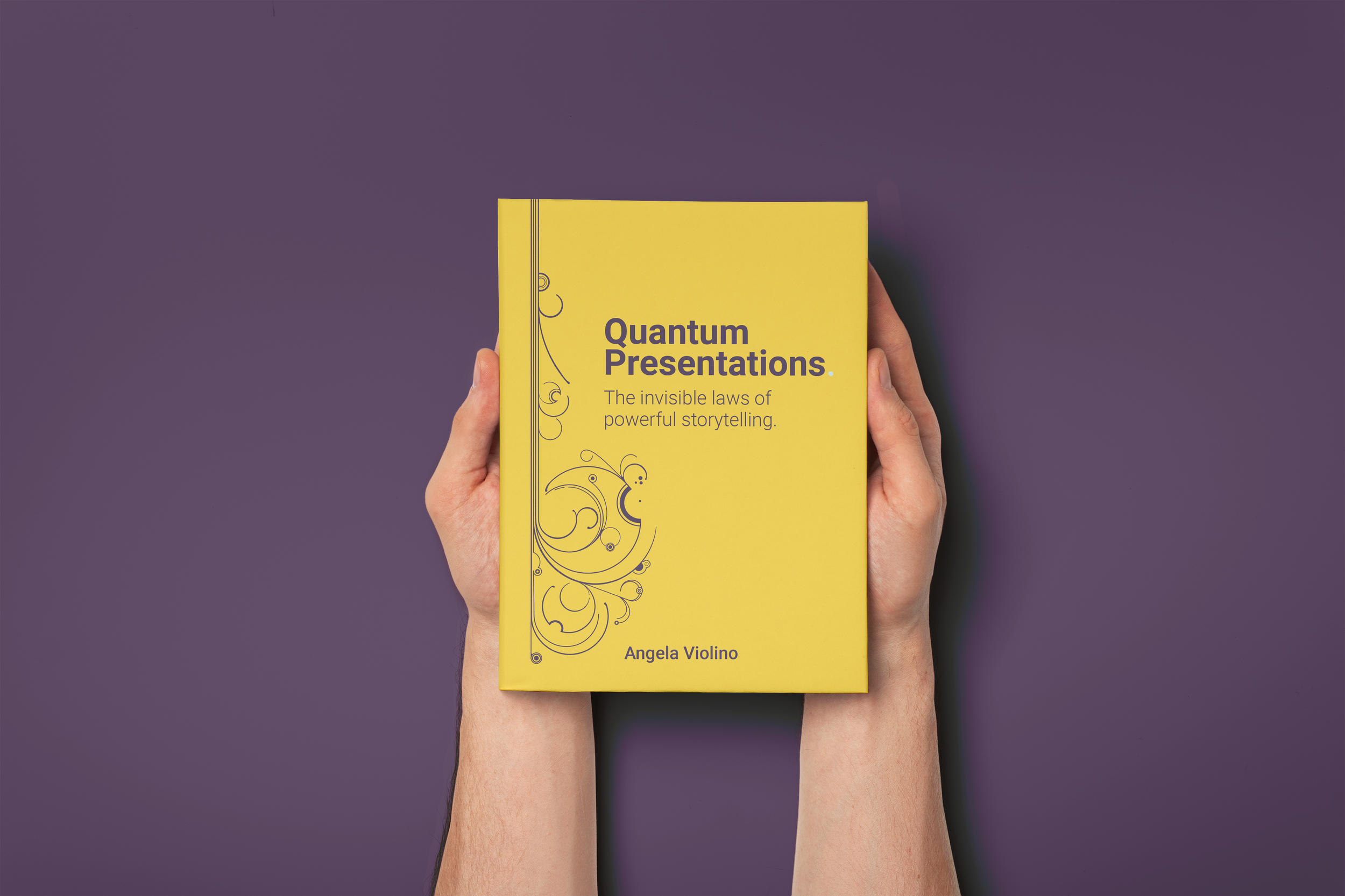
I’m working on the expanded version of this project: a book that brings together method, exercises and practical applications to improve message, design and delivery.
If you want to be notified when the book is ready:
Want to build a presentation using this method?
I design corporate presentations, executive storytelling, high-impact pitch decks and visual narratives for brands and leaders.